









A new risk management model to strengthen the integrity of naval systems at RECSI 2026
Here is the translation into British English, preserving a formal and academic tone:
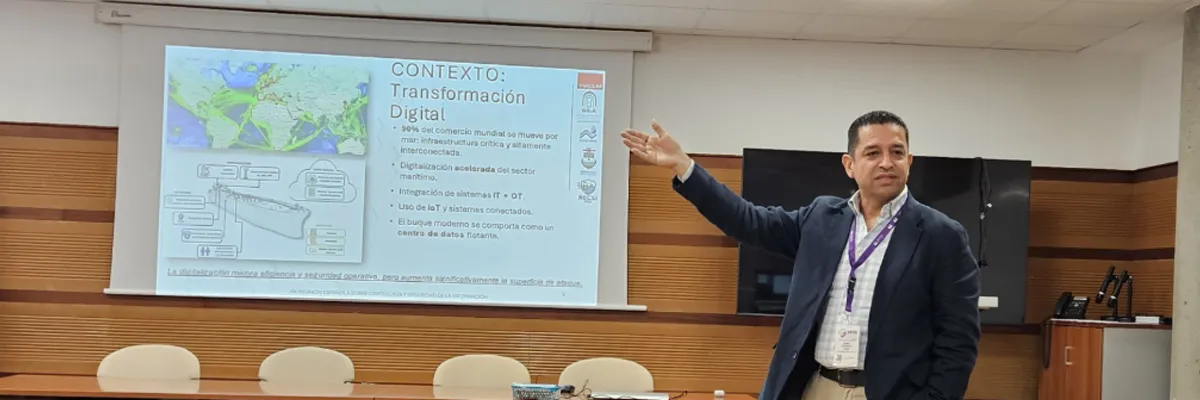
Within the framework of the 19th Spanish Meeting on Cryptology and Information Security (RECSI 2026), held at the University of La Laguna (Tenerife) from 18 to 20 March, Lieutenant Commander of the Colombian Navy, Ferney Martínez Ossa, presented the paper entitled “Maritime cybersecurity: protecting digital seas”.
The officer, who serves as a researcher in the Security and Auditing Group (GSyA) at the
University of Castilla-La Mancha and is a member of the PRODIN Group at COTECMAR (Science and Technology Corporation for the Development of the Naval, Maritime and River Industry), addressed in his presentation the critical challenges faced by the maritime sector in the context of its rapid digital transformation. The study highlights that, as the industry integrates information technology (IT) and operational technology (OT) systems, the attack surface has expanded dramatically. This turns modern vessels into floating data centres highly vulnerable to risks such as ransomware, manipulation of navigation systems, and electronic warfare—an environment in which traditional security measures are no longer sufficient.

In response to this issue, the research proposes POSEIDON (Procedures, Operations and Standards for the detection of Integral Events and the Development of Naval Operating Capacity), a comprehensive framework specifically designed for the realities of the maritime sector. This model aims to align naval operations with international standards, while incorporating specific considerations for the maritime environment, promoting operational resilience through the synergistic integration of technology, governance, and a culture of digital protection. The proposal was noted for its strong practical impact on shipowners, shipyards, and maritime authorities, offering a robust structure for continuous risk management and regulatory compliance in critical infrastructures.
The inclusion of this proposal in the RECSI 2026 programme—a leading scientific forum in Spain for this discipline—was the result of a rigorous evaluation process conducted by subject-matter experts, who validated its technical quality. This academic endorsement underscores the relevance of the research, which was highlighted during the event for its innovative nature and its capacity to deliver disruptive solutions in highly specialised technological fields.